Table of Contents
Google Search Console is one of the most valuable tools in any SEO stack. But the native interface is limited — you can only see 16 months of data, you can’t compare properties side by side, and there’s no easy way to share performance with a client without giving them direct access to your account.
Connecting Google Search Console to Data Studio fixes all of that. Your organic search data flows in automatically, updates on its own, and lives in a dashboard you can share with anyone. In this guide, we’ll walk you through exactly how to connect it — step by step — and show you what a solid Search Console report looks like once it’s set up.
What You Need Before You Start
Before connecting anything, make sure you have the following in place:
A Data Studio account. It’s free with any Google account. Visit datastudio.google.com and sign in with your Google credentials.
Access to a Google Search Console account. You need verified website property access inside Google Search Console — make sure the property you want to report on is verified and has sufficient permissions.
Pop-up blockers disabled. Google’s OAuth authentication window needs to open during setup, so make sure pop-ups aren’t blocked in your browser.
A Data Bloo account. Sign up for free at hub.databloo.com.
Does Data Studio Have a Native Google Search Console Connector?
Yes — Google offers a native Search Console connector inside Data Studio. So why use Data Bloo instead?
The native connector works, but it’s basic. You get limited flexibility on dimensions, no pre-built reporting template, and no central Hub to manage multiple properties or other data sources alongside it. If you’re building SEO reports for clients, or managing multiple websites, you end up doing a lot of manual configuration to get the same result.
Data Bloo’s connector gives you a ready-to-use template, a central Hub to manage all your connected properties and other connectors in one place, and a faster path from “just connected” to “report is live.” It takes the same five minutes either way, but you get a lot more out of the box.
How to Connect Google Search Console to Data Studio Using Data Bloo
Data Bloo’s Google Search Console connector is a fast, no-code way to get your organic search data into Data Studio. Connect your account, select your properties, and your data starts flowing.
There are two ways to do it: through the Data Bloo Hub, or directly from Data Studio. Both take about five minutes.
Option A: Connect via the Data Bloo Hub (Recommended)
The Hub gives you a central place to manage all your connectors and data sources in one spot.
Step 1: Sign in to Data Bloo
Visit hub.databloo.com and sign in using Google or your email and password.
Step 2: Navigate to Google Search Console Data Source
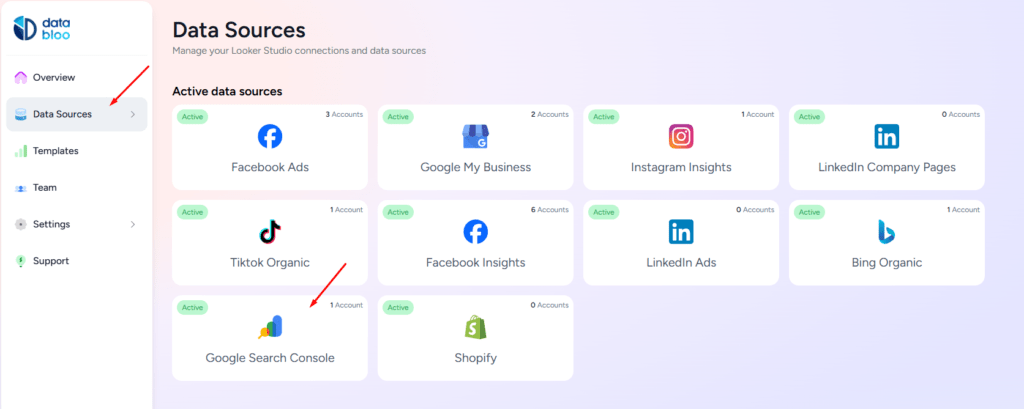
After logging in, go to Data Sources from the left menu. You’ll see all your active connections and an “Add new data source” section below. Click Add new connection and select Google Search Console.
Step 3: Connect to Google Search Console
Click Connect with Google Search Console. You’ll be redirected to Google to authorize Data Bloo. Approve the requested permissions to allow secure access to your Search Console data.
Note: If the OAuth window doesn’t appear, check that pop-up blockers are disabled and that you’re logged into the correct Google account in your browser.
Step 4: Select Search Console Properties
Choose one or more verified Search Console properties to connect. Select the website(s) you want to report on.
Step 5: Review Connection
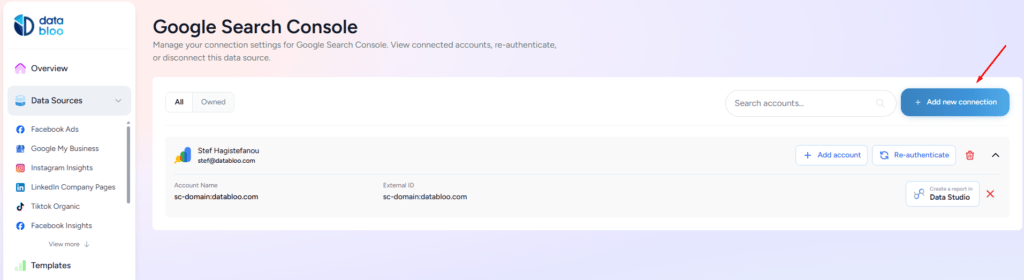
Your connected properties will appear under the Google Search Console data source. You can add or remove websites at any time.
Step 6: Create Your Report in Data Studio
Next to each connected property, you’ll see a “Create a report in Data Studio” link. Click it and Data Studio opens with your Search Console data source already connected. From here, you can build from scratch or use a pre-built template.
Option B: Connect Directly from Data Studio
Prefer to stay inside Data Studio? You can add the Data Bloo connector from there too.
Step 1: In Data Studio, click Create → Report and then Add data.
Step 2: Search for “data bloo” in the connector search bar. You’ll see all Data Bloo partner connectors appear. Select Google Search Console – Free.
Step 3: Data Studio will ask you to authorize the connector. Approve access for both Data Bloo and Google Search Console. Click Edit and share at the top right, then in the modal window, click Acknowledge and save.
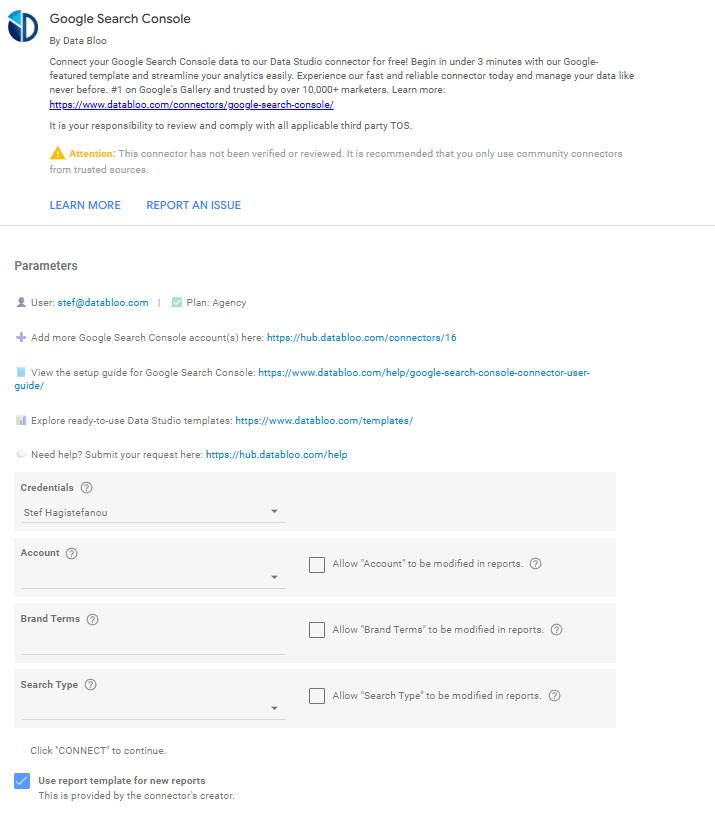
Important: Wait a few seconds for the report to fully generate. Don’t perform any actions until you’re redirected to the edit mode of the report.
Step 4: Click Connect, then Create Report. Your Search Console data source is live and ready to use.
Tip: Check the “Use report template for new reports” box on the configuration screen. It applies a pre-built Data Bloo layout automatically — saving you from starting with a blank canvas.
Use a Ready-Made Google Search Console Template (Faster)
Building a report from scratch works, but it takes time. The faster approach — and the one most agencies use — is starting from a template.
Data Bloo’s Google Search Console template comes pre-built with the charts, KPIs, and layout you need to start analyzing organic performance right away. Connect your data source, and your report is ready in minutes.
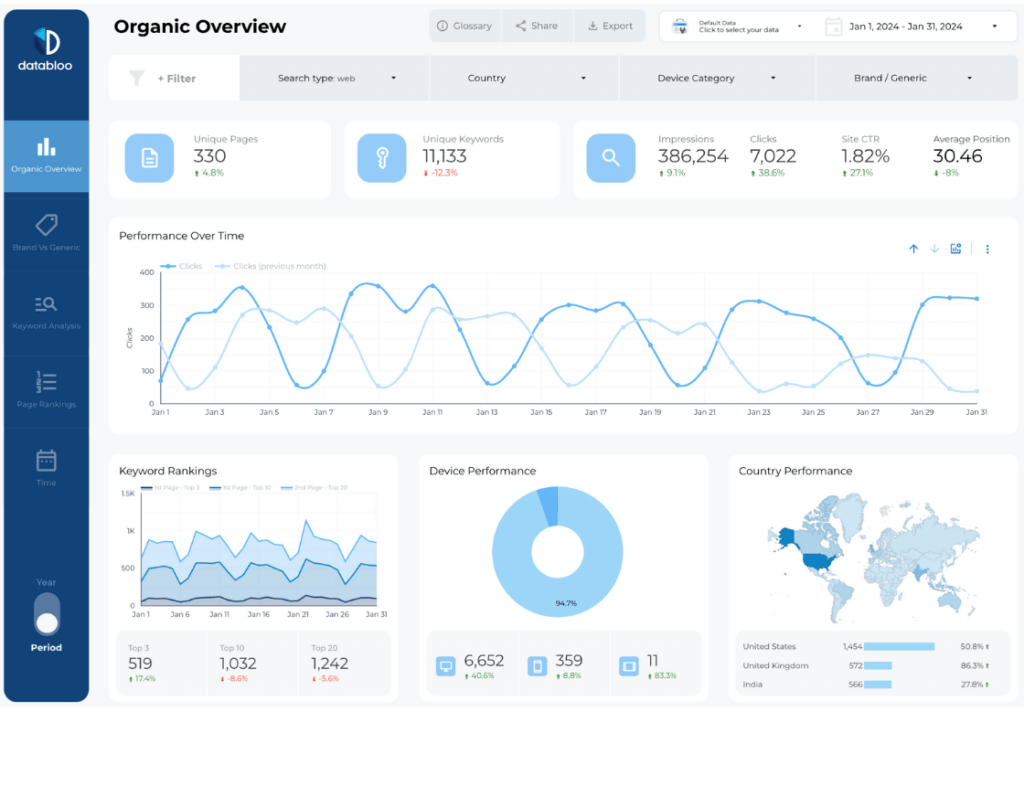
The template covers clicks, impressions, CTR, and average position at a glance, query and landing page performance breakdowns, country and device analysis, search appearance tracking, and date-based SEO trend analysis.
If you need to white-label it for a client, you can swap in their logo, apply their brand colors, and remove any pages that aren’t relevant. Unlimited edits, no restrictions.
Key Google Search Console Metrics Available in Data Studio
Once you’re connected, you have access to the core SEO metrics that matter most for organic reporting.
| Metric | What It Tells You |
|---|---|
| Clicks | How many times users clicked through to your site from search |
| Impressions | How many times your pages appeared in search results |
| CTR (click-through rate) | The percentage of impressions that resulted in a click |
| Average position | Where your pages rank on average in search results |
| Queries | The keywords driving traffic to your site |
| Landing pages | Which pages are attracting organic search visits |
| Countries | Where your search traffic is coming from |
| Devices | How your traffic splits across desktop, mobile, and tablet |
Dimensions for Segmentation
Breaking performance down by the right dimensions turns a generic SEO report into a useful one. Key dimensions include query, page, country, device, and search appearance. This is especially useful when you want to compare branded vs. non-branded traffic, identify top-performing landing pages, or track keyword trends over time across multiple properties.
Customizing Your SEO Reporting Setup
If you need to modify your Search Console reporting setup beyond the default — for example to compare multiple websites or properties, run page-level or query-level SEO analysis, filter branded vs. non-branded traffic, or manage SEO dashboards for multiple clients — you can do that directly in Data Studio.
To edit the data source configuration: open your Data Studio report, go to the top menu and click Resource → Manage added data sources, then click Edit next to the Google Search Console source. Adjust your selected dimensions, metrics, or filters, then click Reconnect and confirm changes.
Common Issues (and How to Fix Them)
These are the three errors you’re most likely to run into — and exactly how to fix each one.
Authentication Expired
Your connection is no longer authenticated, so Data Bloo can’t retrieve your Search Console data. This usually happens when the access token expires, the token is revoked, or your login credentials changed.
To fix it: go to hub.databloo.com, open Data Sources → Google Search Console, and click the Re-authenticate button on your connection. If that button isn’t available, click Add new connection instead. Reload your Data Studio report once reconnected.
Session Invalidated
Your authentication session is no longer valid. This happens when an access token expires, after a password or security change, or due to prolonged inactivity.
To fix it: go to hub.databloo.com, select Data Sources, and click Add Account. Re-select your account or click Skip — this generates a new access token automatically. Reload your Data Studio report after reconnecting.
Account Required
No property is selected for the data source, so the connector has nothing to query. Metrics and dimensions are tied to specific properties — without at least one selected, the report can’t run.
To fix it: open your report in Data Studio, go to Edit data source → Edit connection, select at least one property under the Account field, and click Reconnect. Refresh your report and data should appear.
A few Search Console-specific issues to know:
Property not visible in selection. Ensure the website property is verified inside Google Search Console using the same Google account used during authentication.
Recent SEO data missing. Google Search Console data may be delayed by up to 48 hours. Try excluding today and yesterday from your selected date range.
Only partial query or page data appears. Search Console applies row limits and anonymization for low-volume queries. Narrow the date range or use filters for more focused analysis.
For a full list of Search Console connector errors and fixes, visit the Data Bloo Google Search Console error guide.
Using Your Search Console Data in Multi-Channel Reports
SEO doesn’t operate in isolation. With Data Bloo’s Custom Master Template, you can blend Google Search Console data with Google Ads, GA4, Facebook Ads, and more — all in one dashboard.
This is especially useful for agencies managing full-funnel campaigns, where organic search performance needs to be viewed alongside paid channels to understand the complete picture. Instead of switching between platforms or sending separate reports, your clients get a single view of everything that’s driving results.
FAQs
How do I connect Google Search Console to Data Studio?
Sign in to Data Bloo, connect your Google Search Console account, authorize the connector in Data Studio, and start with the ready-to-use SEO report template.
Is this connector for Google Search Console to Data Studio free?
Data Bloo offers a free plan that includes one account per connector and up to 300 daily refreshes. Check the connectors pricing page for current plans.
What happens if I reach the daily refresh limit?
Once you hit your plan’s daily refresh limit, data will stop updating until the limit resets. Upgrading to a paid plan increases your refresh allowance.
Can I connect multiple Search Console properties to one report?
Yes. During setup you can select multiple verified properties, making this useful for agencies and businesses managing several websites from a single dashboard.
Can I white-label my Search Console report for clients?
Yes. Data Bloo templates support full white-labeling — add your client’s logo, apply their brand colors, and share via a private link or scheduled email delivery.